
Earth's Greatest Enemy: Abby Martin on US Militarism and the Environment
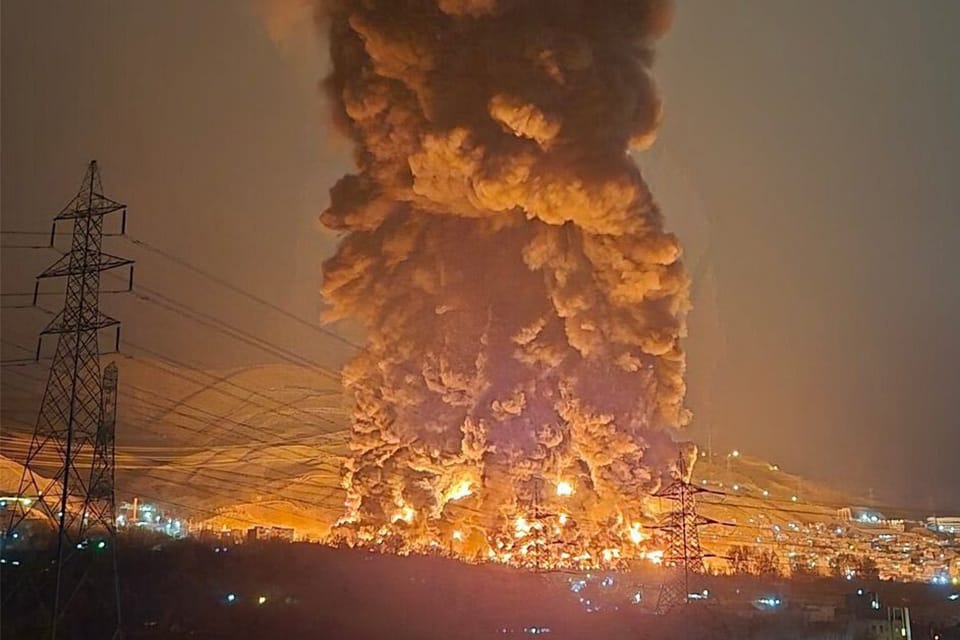
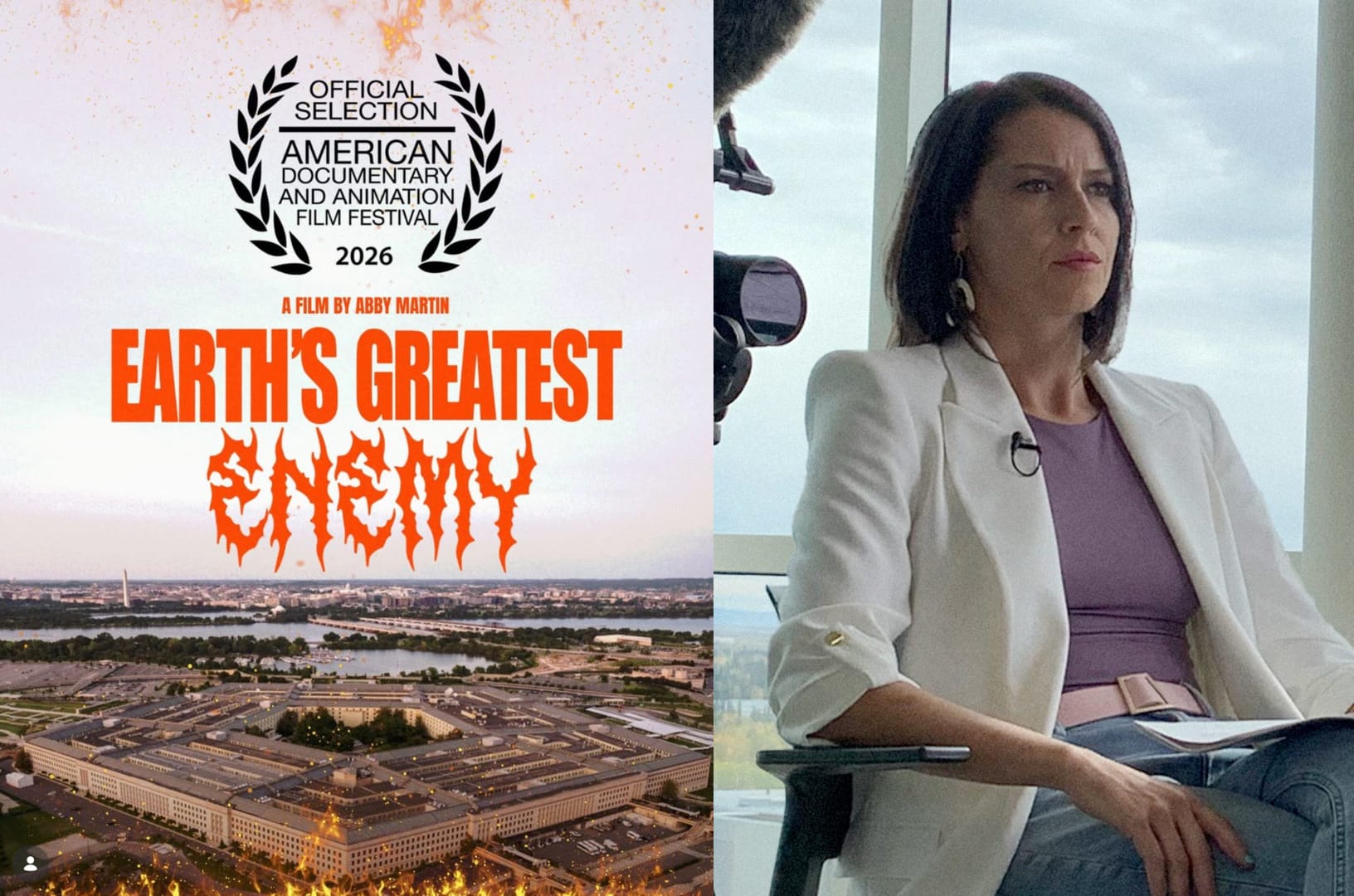
The International Union of Scientists (IUS) was honored to host a livestream interview with investigative journalist and filmmaker Abby Martin about her latest documentary, Earth's Greatest Enemy.
Video
About the Film
Earth's Greatest Enemy is a groundbreaking documentary exposé of the world's largest institutional polluter: the United States Armed Forces. Exempt from international climate agreements and rarely scrutinized in mainstream reporting, the Pentagon is the single largest institutional emitter of greenhouse gases on Earth, while its operations poison ecosystems, contaminate water supplies, and scar landscapes across the globe. In this livestream conversation tomorrow, we will discuss the documentary's central arguments with journalist Abby Martin, director of this breathtaking film.
Transcript
Adam Claridge-Chang: Hello, everyone. My name is Adam Claridge-Chang. I'm a contributor to the International Union of Scientists. And today we're thrilled to be joined by Abby Martin, the fearless investigative journalist and filmmaker whose work has illuminated the machinery of empire. For years, through her show The Empire Files, she has brought us unflinching coverage from the front lines of American militarism with journalistic courage. Now her documentary, Earth's Greatest Enemy, is a devastating exposé of the Pentagon as the single greatest threat to life on our planet. The film is breathtaking in scope as it portrays how the U.S. military pollutes and destroys the environment around the world. Abby Martin, thanks for joining us.
Abby Martin: Thank you so much for having me. It's an honor to be here.
ACC: Great. So we are speaking as Israel and the U.S. restarted hostilities with Iran. And this current aggression is part of a grim sequence of wars that began in 2003, when, in the wake of 9/11, the global outpouring of support was countered with the Bush administration's lies and belligerence. We've had this sequence — a generation of war — that grew out of that. How did witnessing the Iraq war influence you to build The Empire Files and eventually make this film?
AM: Yeah, and I think it perfectly encapsulates this era of impunity that we're living in — which is how we got to a place where genocide is the status quo, where the U.S. and Israel remain untouched, with the global community kind of acquiescing to this. It's because it really did start. I mean, history didn't start on October 7th, as we like to say. This has been an ongoing project by the most ultra-militaristic hawks in the administration. This is a bipartisan thing that's been ongoing.
The Iraq war set the stage. This was a criminal war of aggression that really catalyzed my awakening to understand what my government was doing in my name around the world — the atrocities that it was committing every single day, and externalizing all of the most violent consequences of this global military empire.
I was a freshman in college at San Diego State, a very militarized city, but also concurrently very kind of absent. People are there to vacation, they're there to party — very broey culture. So I was just like, why does no one care about the fact that all of a sudden one day the news was talking about Bin Laden, then the next day they're talking about Saddam? How — it just seemed so bizarre, like the matrix was glitching for me. And I just never looked back. I dove into research and started to unpack what my government was doing. How did this happen?
And — oh, God — becoming a journalist was paramount, because it was the media's failure. First it started with the Bush administration, and then I realized it's the whole system. It's the entire apparatus of Democrats allowing this. You know, Nancy Pelosi — impeachment was off the table for Bush. And then I realized, why is the media lying? The media is an arm of this. The media was an extension of the system that was manufacturing consent for this. So I became a journalist out of necessity.
I was unapologetic in my advocacy and in uplifting the most marginalized voices that are impacted by the system of imperialism. That's always been my beat. The Empire Files was basically an extension of my daily reporting from Russia Today — which we could talk about. I spoke out on air against Russia's aggression in Ukraine, and then it led me to The Empire Files, my own independent investigative series with my partner Mike Prysner. Through that, going all around the world, independently being able to tell these stories — that's what led us, of course, to the two feature films that we did and the film that we're talking about today.
ACC: Yeah. I think that time was also quite defining for me, and I think a lot of people woke up to what was going on. So Earth's Greatest Enemy shows the Pentagon to be the single largest creator of ultra-contaminated Superfund sites in the United States. These are very hard to clean up — toxic sites — and shockingly, many are situated in the same working-class neighborhoods that disproportionately send their young people into military service. But the Department of War is not starved for cash, yet it cheaps out on prevention and remediation. Why do you think the military is so comfortable poisoning its own people?
AM: Yeah, and I think it's really important. I'm sure a lot of your viewers will understand the notion of Superfund sites. I want to first address the premise, because it is so startling in its scope and scale: most Superfund sites in the U.S. either currently house or have previously housed military uses.
It is such a racket. It's such a bureaucratic nightmare — you don't want to claim toxic sites in your state, so you do everything you can to hide these, because you don't want to account for the remediation. You don't want to put them on the National Priorities List, because then you actually have to deal with this stuff. So much is hidden and obfuscated, and so much needs to be remediated, and we don't even know, because of how much censorship there is on this issue.
Think about the environmental regulations that exist here, and the lack of them all around the world, with the 800 to 1,000 bases. Every base is a toxic dumping site and a testing ground — for the indigenous community and, of course, for the communities here. You mentioned these are among the most sacrificed communities, in these sacrifice zones that are already predominantly poor, working-class, marginalized, Brown and Black communities, that are receiving the brunt of toxic pollution no matter where they live. These are the communities that are most preyed upon to enlist in the military. And, of course, they receive the brunt of environmental toxicity and devastation.
Look no further than the burn pit victims. Just the denial of care. This is the M.O., the modus operandi of the military. They will have all of these ticking time bombs all around the world. Look at the Red Hill disaster. Look at Maryland — what just happened a couple of weeks ago. This was 32,000 gallons of jet fuel that was dumped from Joint Base Andrews in Maryland that flows directly into the Potomac River. They denied it for a week, just like the Red Hill disaster. They deny, they deny, they deny. They let all of their service members and the local community be poisoned, drinking jet-fuel-laden toxic water. And then, when they see the disease and the effects and the consequences of this poisoning, they deny the claims. They actually deny the claims.
And you see the effects of this decades later. We look at somewhere like Camp Lejeune — they're still denying the claims. They're waiting for these people to die. Look at the 9/11 first responders. These were the so-called heroes of 9/11. They were used as cannon fodder for propaganda all over the world, and then they were denied. They were denied healthcare. You had Jon Stewart in Congress. This is the system. This is what the system gives us: callous disregard for the sanctity of human life. This is what I do feel capitalism breeds. It's not unique to the military in the way that it engages with human life. This is all corporations. This is the devaluation of life itself under capitalism.
ACC: Yeah. It just seems like they could make an industry out of the cleanup — there would be more money to go around — but it's almost like a gleeful, psychopathic thing, that these people don't count or something.
AM: It's like they're willing to poison themselves. That's what's so bizarre. To the gentleman's point that was just on — a lot of these people go from one base to the next. They're there for two- to four-year stints. But still, how are you doing this? How are you knowingly engaging in criminal negligence, knowing that you are poisoning the planet — that water and air, they're not contained. There are no barriers and borders to this. It's a holistic, systemic thing. So it is very perplexing.
ACC: Yeah. It's disturbing. So one of the many dramatic sequences in the film was the protests in Okinawa. Again, this is another case where I've been hearing about military bases in Okinawa for decades. What did you find in Okinawa?
AM: Yeah, this was one of the things that first exposed me to the scope and scale of U.S. imperialism, back when I was reading Chalmers Johnson's book Blowback. I was so alarmed at the situation in Okinawa and how much it exemplifies this brutal subjugation of U.S. imperialism around the world.
Okinawa is an island that's been colonized both by Japan and the U.S. Since World War II, the U.S. has maintained this antiquated Status of Forces Agreement that is basically a colonial holdover. It subjugates the Okinawan people, and it gives them no sort of authority over their own island. They're in this kind of stalemate between Japan and the U.S. that just treats them like indentured servants. They have no oversight on environmental law. They have no ability to regulate the bases there.
All of this is to say, there are 32 U.S. military installations on an island that is smaller than the state of Rhode Island — one of the smallest states here. That's what's so crazy about it. The whole island is just one big base. And if that weren't bad enough, they're building more. They're building a base in Henoko Bay, which is this pristine blue coral reef. It has like 30 endangered species, including the dugong, which is sacred to the indigenous Okinawan people. There's this exercise in futility and absurdity where they're just blowing up a mountainside, razing all the land, to landfill this beautiful blue ocean.
And it's bizarre, because it's literally insane when you look at the impossibility of even building there — because it's the soft seabed. You can't even really build infrastructure to maintain this base, which is why it's been going on for several decades. But they just continue to do it, because they're just making money. The military operates as a for-profit corporation, so they're just pouring money into this in an exercise of pure futility.
What the Okinawan people are doing there — they've been putting their bodies into the gears of this machine for decades, to slow down the construction, by some estimates up to 50%. They've been slowing it down by slow-walking in front of the machines, the trucks that dump the bed into the ocean — just militant civil disobedience and organizing. It's incredible what they're doing. We were there and captured some of the civil disobedience on the kayaks, where they go and actually confront these ships in the middle of the ocean and they get arrested. You don't see this stuff on the corporate media, and for a good reason.
ACC: Yeah. Chalmers Johnson — that book came out maybe 20, 30 years ago, right? And I think the premise was that the situation in Okinawa was so unbearable — the environment, the rapes, the violence — that there would be blowback. But at least in Japan, they're still sort of under the thumb. Okinawa and Japan, they're still under the thumb of the empire. The thing that astounded me in the film was that you interview, I think, the governor of the island, and he's denouncing the U.S. military, and he's just like, "Well, I'm unable to do anything."
AM: No, that's a really important point. They can't do anything beyond what they're doing, and it really does fall back to us in the imperial core and our respective Western countries that are literally causing this to happen and laying the groundwork for it every single day. The diplomatic cover for this global military empire to operate under the cover of darkness and impunity — and not providing independence for people like Governor Denny Tamaki, who literally ran on a platform to shut down these bases, and he simply cannot do anything about it, because they are living under the boot of the U.S. empire with a gun to their neck.
ACC: So the U.S. military was permitted voluntary reporting under the Paris Agreement, effectively writing the world's largest polluting organization out of climate accountability since at least the start of the Gaza genocide. But way before then, Washington has displayed open contempt for the UN Charter and other treaties, like the Geneva Convention. What does the Pentagon's climate exemption even mean now that the architecture of global cooperation — I think most pronouncedly in the post-genocide era — is just collapsing?
AM: Yeah, this is a bizarre, really unprecedented moment that we're in, for so many reasons. I can't even imagine being a scientist. You guys — for the longest time we were just like, the science is all... they'll follow suit. The science will be put out, and then of course they'll do what the science dictates. And we have seen the opposite. People reverting to conspiratorial thinking and cult frameworks and trauma responses — it's like you cannot face the truth. You can't face the truth.
And I think there's no better example than climate change today. Twenty years ago, people were talking much more about climate change. It was much more on the radar of human consciousness — just the fact that humans cause impacts on the environment. For God's sake, we caused a hole in the ozone layer, and we rectified it with global cooperation. It's just bizarre to think that people are so far removed and detached and abstracted from this, that they can see fires on their doorstep and blame DEI or Karen Bass. It's just like — what are we talking about? What in the hell is going on?
So, of course, back 20 years ago, during Kyoto — which was the first-ever climate conference, led by Bill Clinton — they paved the way for the exemption of the Pentagon back then. And, of course, every other country followed suit, because why would they voluntarily put their country's military emissions in if the U.S. didn't? So it was always a farce, because we were never actually counting the totality of our emissions. Then, of course, Paris came in 2015, and it was voluntary to put your military emissions in. So, of course, no one's going to do that. But at the end of the day, none of this was ever binding anyway. It was always just, "Let's pat ourselves on the back. Let's pave the Amazon rainforest, fly a bunch of delegates out there, just to talk about market-oriented approaches for climate change" — which we all know is not going to do anything. It's not going to move the needle.
And, of course, in the framework now of the complete collapse of international law — any sort of semblance of internationalism, which was always, let's be honest, a farce and a front for U.S. power. The UN — the U.S. has always had veto power at the UN Security Council. All of the rules-based order was always designed, again, in this colonial mindset where the U.S. basically has the ordained right to dictate whatever it wants around the world, and it uses these international bodies to try to have some sort of diplomatic cover and cooperation. But we all know the truth, and this moment has really exposed that truth — that the U.S. has been holding the world hostage, that all these institutions have been hanging on by a thread, by U.S. power and subsidies. So we're in a moment where we have the ability to reshape the world. But it's not the law that's the problem. It's the application of the law. The law just needs to be applied evenly — and against the U.S. and its greatest ally, Israel.
ACC: Yeah. In the film you speak about your children's future and the importance of mitigating climate change, and the coming — presumably the coming — climate wars. I know Americans, of course, want a bright future for their children, and yet, for example, when I bring these issues up with liberal Americans, liberal American scientists, they often deflect — it's like, "Oh, yeah, but what can we do?" So can we hope that Americans will make this connection and eventually turn against their military and its political scaffolding?
I was just listening to a conversation between two North Americans, and they were saying everything in China is possible because they had this violent revolution for 25 years and they took control of the government — but that revolution hasn't happened in America. These are my friends, people who are just thinking about the day-to-day of their lives and not really seeing it. It's like the frog in the proverbial water. So do you think this can happen? I don't want to be a downer, but there's flickers of movement, and I don't know. What do you think?
AM: Well, there's so many things to say. I do maintain revolutionary optimism at this moment, just because — we're both millennials, I'm assuming — I have never seen a moment like this in terms of the consciousness linking international issues together and understanding the foundational current of capitalism driving this. Because let's face it, all of these movements in the U.S., the ones that had a lot of revolutionary potential and potential to really build into mass movements that could seize power to our demands, have become co-opted and defanged by the very institutions that profit off our destruction, curating our reality, as we see.
So this is something I think is really novel. I have never seen this before, where people are completely able to speak about capitalism honestly and frankly. Ten years ago, it was completely taboo. No one was talking about this stuff. So to link capitalism to imperialism as the driving force of this multi-pronged struggle — to link all these issues together, to understand how Gaza is the connective tissue, why ICE is in the streets, why every bomb that goes off in Iran is an explosion here in the poorest communities, robbing us blind, draining our energy and our life force and all of our money — the $1.5 trillion military budget. All of these things happening — watching an ecocide in Iran while gas is $6 a gallon.
So I think Americans are completely awake, for the most part, but they're surviving day-to-day. They're struggling so much to survive. We see the statistics — 70% of Americans are literally living paycheck to paycheck. That is insane. So I don't even understand the organizational capacity if you are that strapped just to survive in this economy.
But to your point — the privileged liberals, the comfortable liberals who care about the environment, who are invested in the habitability of this planet, who understand the stakes — it's time to wake up. We don't have the luxury of time anymore. They do need to see this movie. And I hate to keep pointing to the movie as the solution, but that's why we made it, Adam. We made it to give us a fighting chance. It's a tool in the arsenal, an intervention to wake people up out of that comfort, to understand: not only can we do something about this — when you look at the Albania situation, that a couple of days of mass movements in the street has already completely changed the outcome that everyone had ceded to, the notion of, "Oh, it was inevitable, the Kushners are going to take over this island." Hey, it's not. Look at Kevin... in Utah. He's already scaling back this huge data center program. It is not too late. We can fight back against these parasites. But it takes mass people's power, and it takes looking at the future with eyes wide open, taking off your rose-colored glasses.
You're scientists. It's time to look at the future and say, "This is how bad it is. We need to act and organize accordingly." We can't just be passive actors anymore. And, yes, I do see hope in America, and we simply have to continue to build on that hope and on that education, because people are ready to activate. They just don't know where to go, because there's no electoral vehicle for them.
They see someone like — what happened with ranked-choice voting. I think mayoral candidacies have much more potential than Senate, Congress, and the federal kind of paralysis that we see in Congress. We see really exciting things happening on local levels — with referendums, pro-Palestine resolutions, divestment campaigns. These are things that are very energizing, especially the fight-back against data centers, which are the new front of the war machine that coalesces all these issues together. So we have to look at what's good, what's working, and organize accordingly.
But first and foremost, we are very uneducated, and we're in the infancy stages of this. So it really has to come back to putting this movie, and the issues that it presents, in front of people's faces, and saying: you cannot call yourself an environmentalist if you are not an anti-imperialist. You cannot throw the global South under the bus. You do not have the right to dictate to other countries how they live. We have to lift this boot off the neck, and we have to decommission this global military empire, because it's killing us. It's killing you and your children.
If they just saw some of the statistics in the film, they would really see that. I've spoken to tons of scientists who have been coming to these screenings — climate scientists, academics — and they're shocked, firstly, because they haven't heard this stuff before. How is it possible that I've gone through my entire academic career and not been presented with the very obvious facts in this documentary? And I've heard a lot of: there's no imagination and ingenuity and creativity outside of corporate and policymaking. We're so confined and restricted in terms of what is possible, because everyone's just put into the system that continues to perpetuate the worst things. So these are all problems that we need to tackle — especially the co-optation of academia by the very industries that we're trying to battle.
ACC: Yeah. That's sort of why the International Union of Scientists exists. We realize that the mainstream publications — obviously they will publish climate science and things like that — but we tried to publish some letters about imperialism and the genocide, and it was "no, no, no."
AM: So what were you told? I'm curious why.
ACC: It was just said, "We're not interested." They didn't really give a reason. But to me it's a little bit obvious, in that most of these journals are essentially organs of empire. They're part of empire. Yes, they want to help people's health and things like that, but there's this other agenda going on, which is that they're part of the system. So they're not going to try to stand up against a genocide. There are small things — the Lancet will publish studies about the extent of the genocide — but they're not going to publish an op-ed or a letter. It has to be in the trappings of a scientific paper. At least on an international basis, there aren't that many outlets for scientists, so we were hoping that this could become a platform for scientists to speak out on these issues, because we know there are a lot of scientists who feel very strongly about this.
AM: Yeah. That's great. And what's funny — I'm curious what you guys think about this poll that just came out from Pew that showed that more Americans believe humans are not causing climate change today than they did five years ago. So it's actually getting worse. What do you attribute that to?
ACC: That, I don't know. I'm not really an analyst of social media. I'm not a sociologist. But I'm astounded at how — particularly the U.S. has become sort of less evidence-based, less evidence-oriented. And I don't understand the forces of why that would be.
AM: Bad education. The greatest propaganda campaign in history.
ACC: Yeah.
AM: Repeat a lie often enough. That's what's so funny about the disbelief in the consensus of scientists — because every scientist I've talked to basically tries to avert being an alarmist. So it's like the least gracious interpretation of the research, because they don't want to be too alarmist-sounding, they want to be the most rational. So it's always probably much worse. Oh my God. What, guys?
ACC: Yeah, that's sort of what happened to me. During the Bush era, I would tell people, "Look, this is horrific, this is a path to ruin for the U.S.," and they would just give me these blank looks, or "Oh, it's overblown." And so then I just sort of stopped. I'm like, well, what am I going to do? Scientists are very interested in their own career and their own topic. I think a lot of them feel like they can't take something like that on.
AM: Yeah. It's like you either go chain yourself to the Bank of America building, like... right?
ACC: Right. We are paid by the state, essentially. The grants come from the state. So we're sort of officers of the state, and in many cases the good boys and girls who studied hard and did everything correct to go and do a PhD or whatever. So it's not something where we're necessarily headed for the streets to protest. It was sort of a force of conservatism, in many ways.
So I was curious — the Pentagon's pollution is generated... You had that incredible passage in the movie where the U.S. Navy just throws trash off the ship. It's like, okay, I didn't know that was going on. They literally just can't be bothered to take it to port. And that pollution is generated while it serves as the enforcer of shipping lanes and the petrodollar. A global transition to decentralized clean energy would deny Washington its two primary levers of control — namely, the ability to sanction oil flows and embargo states, and the petrodollar's role as a reserve currency. How do you see the role of the U.S. military in enforcing this fossil fuel system globally?
AM: It is the enforcement mechanism. It literally exists to enforce global capitalism at the barrel of a gun. And that global capitalist system is upholding an unsustainable fossil fuel infrastructure. In fact, it's always been predicated on this. If you look at the first extraterritorial bases that the U.S. military built, it was to protect coal and coaling stations. Of course, that changed to oil once oil was discovered and became the predominant national security priority. But every single base is a story of these supply routes, shipping lanes, and the arteries of global capital.
That's why we see Israel as such an essential ally in the Middle East — because it's where the heart of the pivot to the modern industrial economy is. It's the heart of capital. It's the oil flow. That is why the U.S. is so hell-bent on — I mean, it's so obvious, right? It's so weird to even talk about this stuff because of how obvious it is. We don't need to interpret it. They're saying it themselves, for the first time. You and I, back during the Bush administration, we had to convince people it's for oil, and people were like, "Okay, yeah, sure." But now he's literally saying they're doing it for oil. It's no longer just a liberal trope. This is explicitly stated as the conquest and pillaging of oil supplies — Iran being the third largest, and Venezuela the first.
So this is the problem: it necessitates its own growth and expansion. We're on a finite planet that's treated as infinite, with infinite resources, and it's based on oil. I was told by several high-ranking generals and military brass, basically infantilized, "You, you idiot — the world runs on oil." And until that isn't true — we're keeping all the sustainable energies at bay. We see how they treat renewables. It's cartoonish. They just had a mascot — I thought it was The Onion, but it's like the coal mascot now. What in the hell? How do you even really analyze this stuff?
But yes, that is why we are in the situation that we're in. This predicament is basically because the military is a for-profit corporation, and it has to grow every single year, and it has to expand, and the only way to do that is to continue to pillage and plunder every last vestige of natural resources. That's why the Iran war is happening. It was an inevitable consequence of what we were living under. It didn't just start with Trump. And that is why we are going after the Arctic as the last final frontier. It's going to accelerate climate change, but they don't care. It's accelerating what they are already causing, because they need the resources to enrich themselves — but it's going to continue to further the warming. It's unbelievable, the self-fulfilling prophecy that we're in.
ACC: Yeah. It's like Camp Lejeune is sort of the micro scale, and then this is the macro scale. It's almost like self-harm out of — I don't know what you call it — greed, or lust for power. And it's sort of "consequences be damned." If you tell me otherwise, then you're the problem — rather than me harming literally myself or my own organization, and destroying the world, just so that I can get ahead. I don't know.
AM: It's this weird pathology where people basically blame it on human psychology because they don't want to point to capitalism, because it is too big and it implicates everything. They look at human psychology and they're like, "It's the bad apples, and if we just got one good one." No. The system rewards the worst characteristics. It rewards the greediest, most sociopathic, sadistic, depraved monsters who don't give a damn about the environment. That's what we get, and that's who's running the world.
ACC: So your shocking 2017 street interviews with young Israelis alerted me, and many others, to Israel's growing extremism — something that has become even clearer since the Gaza genocide. Why is the U.S. military keen to partner with this criminal entity and assist such extreme violence? I think even those who still believed in the goodness of the U.S. — that has been largely dispelled around the world, if you look at the polls. So this is sort of the next stage. Why do you think the U.S. military is so keen to do this?
AM: I think you just answered the question when you said "the maintenance of the system, consequences be damned." Even something like the Iraq war actually waned U.S. hegemony in the public consciousness, in terms of support for the corporate media, support for institutions. It really cemented this distrust, this detachment, this widening schism between the ruling class and the people. And that was damaging, largely, to the imperial project. Look at Latin America.
To go so hard on Iran, and lose this wide swath of the right wing — to say that the staunch ally Israel can do whatever, and not waver for a second, and not try to stop them from doing the most heinous war crimes — the rapidity and succession of war crimes that makes every other era pale in comparison, just the systematic slaughter of journalists alone, and healthcare workers. Why? If that wanes this kind of support for U.S. hegemony and Israel — which obviously survives and thrives on the belief in Zionism, that is literally why it has been able to do all this — so why "consequences be damned"? When you're a hammer, every problem's a nail. And they don't care. They just have to keep getting that oil and getting that money and lining the coffers of the defense contractors, and that's it. It's one foot in front of the other.
There's no long-term plan here. The plan is to knock down every pillar of the remaining independent states that are basically barriers to the whole global military dictatorship. Israel, to your point, is a very essential partner. I think this was cemented and solidified back during the '67 war, when the United States empire saw Israel's utility to tamp down on anti-colonial movements. They saw what they were willing to do, to take and colonize land. And so they said, "Hey, we can use Israel." That's exactly what we did. We strengthened our relationship with Israel; we continue to subsidize it to such an extreme degree. Because look at who's surrounding Israel — Lebanon, Iran, Syria, all of these enemy states that the U.S. wanted to control, put under its boot for so long.
Look at Wesley Clark, the former NATO commander. He was told, I think by Dick Cheney or something, right after 9/11: "Seven countries in five years. That's the goal. That's the Project for the New American Century goal." And he said, "What do you mean, seven countries in five years?" And guess what? We've done them all except Iran. And that's what we're doing now. This is what we get when you're a hammer, and when there's no long-term plan, and there's not even a military plan. They've never won a war, because it's not about winning. It's not about strategy. It's about money — and consequences be damned.
ACC: Right. It's kind of shocking. So the U.S. military, as you say, hasn't really won many wars, but they've spent decades cultivating an aura of invincibility. And yet the Ukraine war and the recent war have demonstrated that when the U.S., and its proxies like Israel, finally face great powers like Russia or Iran, Washington cannot easily prevail. Will such strategic defeats — or seemingly apparent strategic defeats — lead to the decline of the U.S. military-industrial complex, with the exhaustion of the intercepted missiles? Or will a humiliated empire become desperate and somehow even more willing to scorch the earth? What's their move?
AM: Well, I forgot to say one thing about Israel that I think is important in this whole perspective, which is that it gives the U.S. cover to do more heinous things. Israel has flattened the moral threshold of how we even react and respond to the worst things that we've ever seen — the AI genocide, this new AI face for warfare. Israel has kind of taken all of this technology, used Gaza and Palestine as the testing ground, and also provided this evil face that gives the U.S. basically the ability to do it now. Like, "we can follow suit, because Israel did it, not us." So it provides so many things for the U.S. It's really horrific.
But look, the U.S. is a dog in a corner that is trapped — and really, so is Zionism. I look at them the same, because they only exist under the weight of their own propaganda. And I'm talking about imperialism and Zionism: this belief in the benevolent empire, the belief that the U.S. is acting in good faith about human rights and democracy. All of this has been demolished. So we can't even subscribe to that anymore. There's no excuse to even believe in this anymore.
Trump has made it really easy. There's no going back to brunch. There's no going back to the status quo. This is what bred Trump. He isn't a king — you know, the "No Kings" mantra. He's not a king. He is a perfect representation of American society and the system that we have. If your fundamental human rights are on the chopping block every two to four years, that's not a party problem. That is a system problem. And similarly, Netanyahu is not an anomaly. He's not an aberration. He's a perfect representation of Israeli society. It is fascist to the core. So this is the problem. This is the rot that we need to deal with.
But, like I said before, we're in a unique moment where we have the ability to seize and reclaim the truth, reclaim our narratives. We see the technocrats for who they are. There's no longer "Google, not evil" — we know that these people treat us like vermin, like dirt on their shoes. We need to stop believing in the notion of good billionaires who are going to save us from ourselves, and start realizing that our community and each other is all that we have, and all that we ever will have.
Overall, I see it completely slipping. This is an incredible moment where people are going to start organizing themselves — parallel systems, BRICS. You already see this burgeoning global order outside of what the U.S. controls. Just what's happening in the Strait of Hormuz really shows you: you can bring the global economy to its knees without even firing a single shot. That's the power — without even asserting yourself militarily, which we can't. We can't fight the world's biggest military militarily, with violence. We have to organize ourselves nonviolently to shut this system down, with the only language that these people speak, which is capital — strikes, boycotts, doing whatever we can.
But I do think it's happening, and I think it's happening now. And it only takes 5%. It only takes 5% to wake up and act, and we can change history quickly. We see how quickly it's changing every single day. And I think it's time to change it for our benefit instead of theirs.
ACC: Yeah, that's great. Well, thanks so much, Abby. I hope that the U.S. — the imperial core — does come around and tries to stop this. I completely agree that at least Trump is honest about what his intentions are. He's not trying to cover it up in liberal, United Nations talk. He's just straightforward that we're trying to steal oil, we're going to steal Venezuela's oil. It's very straightforward, and it becomes much more apparent. But it's also an acceleration toward that moment when the hegemon declines, and we don't know what this sort of wounded, psychopathic monster is going to do as it realizes that its power is limited. So it's both a moment of clarity and quite terrifying, I think.
AM: It is. And the truth remains that we must decommission this military empire. We have to — for the sake of our species, for the survival and habitability of the planet. We must. It's not a question anymore. It's a necessity. Whatever that looks like, and whatever we have to do — we have to. So I really appreciate you giving me the space, and for all of your advocacy and efforts. It really means a lot. Anyone can watch the movie, Earth's Greatest Enemy — EarthsGreatestEnemy.com. You can rent it. It's also coming out on streaming networks July 4th.
ACC: Yeah, it's a great film, and everyone should definitely rent it and watch it. Thanks so much, Abby. Great talking to you.
AM: Thank you so much. Bye-bye.
Event Details
Link: Livestream on https://www.youtube.com/live/0uFfRnwpiLY
Date: Monday, 8 June 2026
Time: 17:00 UTC
Format: Livestream interview
Film: https://earthsgreatestenemy.com/
Rent and watch the film: Earth's Greatest Enemy.

Comments ()