
Carlo Rovelli on Nuclear Risk, Militarization, and the Responsibility of Scientists
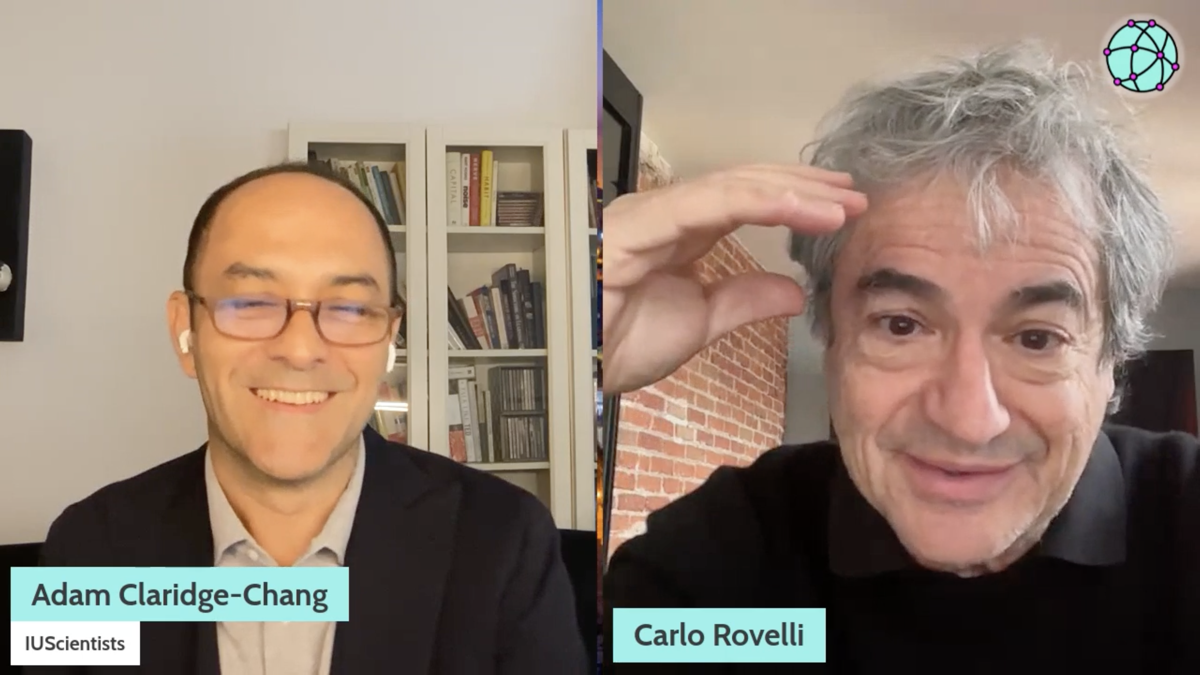
A conversation with Adam Claridge-Chang
This conversation was recorded in February 2025 — just before the US-Israeli attack on Iran. It marks the first anniversary of the Scientists Against Rearmament manifesto, co-authored by Carlo Rovelli. The manifesto calls on scientists, engineers, and scholars across Europe to resist the EU's €800 billion ReArm plan and to uphold the tradition of scientist-led diplomacy and de-escalation. A year on since the manifesto, the geopolitical situation has only deteriorated.
It was a privilege to speak with a leading scientist who has opposed war and militarism as a lifelong conviction, with views tested and refined over half a century. As the world accelerates towards global catastrophe, it is critical for scientists to stand up and oppose the normalization of militarism in research, in institutions, and in public life.
Adam Claridge-Chang, IUS: Today I'm joined by Carlo Rovelli, an Italian physicist and leading architect of loop quantum gravity. He is also known internationally for bestsellers like Seven Brief Lessons on Physics. As co-author of the Scientists Against Rearmament manifesto, he argues that scientific inquiry into the structure of reality carries an ethical imperative towards cooperation rather than confrontation. He's also a member of the International Union of Scientists. Thanks for joining us today, Carlo.
Carlo Rovelli, IUS: Thank you very much, Adam, for the opportunity of expressing some ideas.
Adam Claridge-Chang (ACC): How did you come to adopt explicitly anti-militarist positions, and do you perceive a continuity between your physics work and your political commitment to planetary cooperation over confrontation?
Carlo Rovelli (CR): Regarding the first question — my anti-militarist positions are very old. They come from my youth. In Italy at the time, military service was compulsory, and I refused to join the army. I was very briefly detained for that. I was in my early 20s, half a century ago. I was pretty lucky, because at the time the Italian army was lightly engaged in Lebanon, and the population was not supporting the government's adventure, so the government was in a weak position and didn't want young people like me to make too much trouble. Because of that, I avoided a longer detention that friends of mine who made the same choices had to go through.
I have some texts I wrote at the time — very much in the spirit of the '70s. Namely: war is bad, period. I don't want to be part of it, period. It's a moral imperative, period. You're never going to have me take a weapon in my hand and kill another human being, irrespectively of everything. That was, in reality, more nuanced for me — it was not a purely a priori, absolute, religious repudiation of violence. It was more a belief that war is most often something that the majority of people suffer for the interests of a few.
ACC: And the second question — is there continuity with your scientific work?
CR: I would say there are a couple of connections. One is just me — I'm the same person. I'm not a different human being as a scientist versus as a political citizen. More specifically, I think theoretical physicists like me feel a kind of shared responsibility for the poison gift that theoretical physics gave to humankind: nuclear weapons. So there's a part of the theoretical physics community that feels — we did that — and the danger that nuclear weapons represent for humankind today is so dramatic that not only as a citizen but also as a theoretical physicist, there is a responsibility to warn humankind that the risk of self-destruction is colossal, very real, very concrete, and constantly disregarded.
I think deterrence saved us from nuclear war for many decades, but that doesn't mean it will continue to do so. It's like throwing dice repeatedly and saying, "well, six is unlikely to come out" — but if you keep doing it, six will eventually come out. Nuclear war is the same. Deterrence makes it more unlikely, but if you keep going, one or the other day, the six will come out.
ACC: Even during the Cold War, when deterrence was arguably functioning, there were many technical accidents and errors that could probabilistically have triggered a nuclear war without much intention.
CR: Yes — during the Cold War there were many episodes in which nuclear confrontation was avoided by very little, by a minute or two. It is an extraordinarily risky game.
ACC: So now, in 2025–2026, the EU has broken the separation between civilian and military research. For example, they opened Horizon Europe to defence projects, and Germany has made large cuts from research budgets to fund plans to remilitarise. What impact do you see the €800 billion ReArm plan having on science in Europe?
CR: I would react to a question like that by saying I don't even want to think about it. It's a little like: you're doing science, and if we give you a lot of money, is that good or bad? Well — good, thank you. But then people say, well, there's a corollary: part of that money is going to be used to kill your children and your friends and a couple of million other people. Are you happy? I said: no, I'm not happy.
Of course, more money for science is good for science. Humankind has a lot of priorities, and scientific research should be part of that. But it is good to invest in peaceful science. The money that goes to military development is a disaster for humankind. It is always spent with the idea that if you want peace, prepare for war — which is exactly what was said over and over again just before all major wars. The First World War was preceded by a period in which everybody said, "we should spend a lot of money on the military to preserve the peace" — and then there was the First World War, rapidly followed by the Second, and 100 million people were killed under the slogan if you want peace, prepare for war.
Rearmament has historically always been a preliminary to major military confrontations. The Cold War killed a lot of people, because the war was displaced around the periphery. And deterrence shouldn't give us the illusion that it will work forever. Things are changing — especially now that there are soon going to be three major nuclear powers, which completely changes the game of deterrence. And more importantly, there is technological development. Deterrence works only at zero technological development. If you and I are fighting and we each know exactly what the other is capable of, we're in a stable situation — neither of us will attack. But if one of us gains a technological advantage, that stability disappears. We're back to: whoever is stronger imposes their will. That has been the rule for 10,000 years of human history. It seems to me humans are rational — they should learn to play a different game.
ACC: In your manifesto you invoke the 1955 Russell–Einstein Manifesto and the Pugwash Conferences as models for scientist-led diplomacy and dialogue today. What concrete actions can working scientists take to resist becoming part of this new Cold War? Is organised refusal of military-linked funding still possible, or is there too much institutional capture?
CR: I think it's hard given the current climate, but I think it's possible. The geopolitical tensions are very much in the news, so it seems to me less and less people can remain in the spirit of "nothing is happening, business as usual." A gross of responsibility is needed from scientists. What can be done concretely? For my part, I definitely refuse to do any work vaguely connected to military spending — not because I change the world directly in this way, but as a sign. For the rest, I don't see what else we can do than talk and try to convince our colleagues to be more responsible, and I would say — less shortsighted. What destroys humankind is irrationality and being shortsighted. A little advantage in the short term is a big disadvantage in the long term. That is what all the wars are. But it is also true for each one of us individually. I have no advice to give beyond what I'm trying to do: writing, talking, expressing opinions.
ACC: Economists like Jeffrey Sachs and others have argued that European submission to American geopolitical strategy — for example, NATO expansion and now the attempted acquisition of Greenland — represents a kind of vassalage. The Rearm plan meets Washington's demand for 5% GDP in military spending even as the US makes threats against Denmark. Will the pursuit of peace in Europe require a decoupling from the American empire?
CR: I think what has happened recently is not hard to read historically. Europe's vassalage with respect to the American empire didn't start with Trump — it was there before. In Europe, it was a very convenient situation: we were the friend of the bully. When you're the friend of the bully, you're protected. The US treated Europe relatively well for almost a century since the end of the Second World War. We had security, trade, and were allowed to some extent to have convenient energy relations with Russia.
At some point, the US changed — for internal reasons, and because the rest of the world is growing much faster than the empire. The rest of the world today is not the small economic power it was 30 or 40 years ago — it's as big as the empire, if not bigger. And what has happened very recently is that the Trump administration completely changed policy toward Europe. Suddenly Europe is in an existential crisis: "Oh my god, who are we? Daddy is not protecting us — daddy is against us." Of course the US was always the bully — the United States has started 30-plus wars in which it was the aggressor, with our complicity — including Italy's. Millions of people were killed while we told ourselves, with pride, we are the good of the world, we are protecting and spreading democracy. The fact was brutal control of the world. The novelty now is that a little bit of the hypocrisy of this story has simply been abandoned.
I think Europe is now in a position where it can become more of an actor on the international stage. It is still probably the world's largest economic power, depending on how you count. It has immense cultural influence. And I would note that on many key issues, the rest of the world is politically much closer to Europe than to the US. On international law —China and Europe are aligned: let's implement it as much as possible; the United States is not. On ecology and green policies — China and Europe are on the same page; the US is not. On the regulation of artificial intelligence—China and Europe agree that we need public oversight and boundaries; the US does not, preferring to leave it in the hands of a few private corporations.
What Europe has to abandon, it seems to me, is the ideological narrative of the "democratic West" that is good while everybody else is bad — that we have top-level values others lack. What the Indian, Brazilian, Indonesian, or Chinese leaderships have done for their populations is appreciated by their populations. They have different values from ours in some respects, and that is fine. We should exit this mentality that we have to teach the world, and that it is us against them. That is what is destroying the world right now.
ACC: I think you're right that the European mindset may be one of the hardest things to escape — this idea that the so-called liberal rules-based international order is the preeminent framework that no one else should challenge.
CR: Yes, and I would make a distinction — I think it's a distinction the Chinese make as well — between the "rules-based" liberal organisation of international affairs on one hand, and a law-based order on the other. There is a UN Charter that all countries adopted. That is not a set of rules invented in some small office by a powerful group of nations and imposed on everyone else. Law is a different thing — the UN Charter, international legality. And the West has constantly broken it. It has broken international law repeatedly since the Iraq War, and the world has asked us to have respect for the United Nations, for the WHO, for international institutions. We need to accept differences of values — which are not so great, because more or less the values are the same all over the planet — write clearly what the law is, and obey it. That is better for everybody. And the first ones to have broken it have been us.
ACC: You've written that European politicians stir up "fear of Russia" while conveniently ignoring that Russia's GDP is lower than Italy's — and therefore that Russia lacks the resources to conquer Europe outright. Why do you think European leaders persist in this Russophobia and militarisation rather than pursuing a diplomatic, negotiated approach?
CR: I don't know. I fail to understand the European leadership right now. The last time I had a conversation with a top person in the German foreign ministry — about a year ago — I was shocked. I repeatedly asked: how do you see Germany, Europe, and Russia in the future? What's your vision? The answer was: "We have no idea. We've lost our way. We don't know where we're going, what we're doing. We've been shocked by the Ukraine war, shocked by what the Americans are doing. We navigate day by day, week by week."
If that is the foreign policy of the most powerful military country in Europe, then Europe is obviously confused. Italy is confused, France is confused, the UK is confused — the British illusion that they were somehow still influencing the Americans has been completely shattered. And in this confusion, the disappearance of American protection has had one collective reaction: "Oh my god, let's build a lot of weapons." As if that would help.
Now, Russophobia — I do understand the concern of some countries that have a long history of confrontation with Russia, like Poland and the Baltic states. They are in a situation not entirely different from Ukraine's, with Russian-speaking minorities and a complicated history. But the idea that today's Russia has an army that could reach Berlin, Paris, Rome, or Madrid? It is such an obvious nonsense. And yet it is used to instil fear in populations. Russia has a big population and is a nuclear power, of course — but you don't get to use nuclear weapons to conquer territory. Remember what happened the last time Russia arrived in Berlin: 20 million people killed, a colossal war. The Russians have no possibility whatsoever of arriving in Rome or Paris.
And the Russians have been saying, over and over again: a confrontation in Europe is the last thing they want. They want security and good relations with Europe. They want to sell us gas, which Europe needs. Modern Russia was created by an elite whose dream was to join the European elites — that is completely transparent. And then the British and Americans succeeded in instilling in Russia the fear that all of this was a manoeuvre to destroy Russia — which is how Russia feels. Wars very often do not start from a desire for conquest. They start from fear. Everyone should read Mein Kampf — not as a programme to be admired, but to understand it: it is entirely about the big powers out there that want to destroy us, that will kill us all unless we become stronger than them. And we're playing the same game again.
ACC: I almost feel that NATO propaganda against Russia has permeated the system so thoroughly that it's not just ordinary people who can't see reality — even the leadership now believes their own propaganda.
CR: I'm afraid that's what happened. Sometimes we say, "well, let's trust the leadership — after all, they have more information than me, so maybe they have a longer view." But I don't think that is reasonable, because if you look at political history, it is constantly misjudgement. Constantly. I've just finished writing a history of nuclear confrontations and the development of nuclear weapons. It is unbelievable how almost all decisions were taken on the basis of convictions that were simply wrong. The United States dropped the first bomb because Truman was sure the Russians would never build an atomic bomb — the Manhattan Project was so colossal, half a million people, an immense amount of money, "the Russians could never do that." A few years later, the Russians had the atomic bomb and then the hydrogen bomb. Korea invaded the South because Soviet intelligence told them America would not respond — America did. Then America invaded the North because the CIA concluded China would not intervene — China intervened. It is all like that, over and over again.
So I don't trust European politicians right now at all. Plus there is the long wave of the Cold War — which was, among other things, a very convenient story for elites on both sides. The American leadership controlled the world with: "bad Russians are going to steal your house and eat your babies." The Kremlin controlled its sphere with: "the nasty capitalists are going to overrun your countries." It is very convenient, when you are in power, to have a big bad dark force against you. And I think the fear of Russia is also a little bit of that, still being played.
ACC: The Bulletin of Atomic Scientists has set the Doomsday Clock at 89 seconds to midnight — the closest to apocalypse ever recorded. Both START treaties have collapsed, and there is talk of modernising so-called tactical nuclear weapon systems in Europe. Do you believe that scientist-led de-escalation — the kind that succeeded during the Cold War — remains possible today?
CR: Yes — to both sides of the question. The risk of nuclear war is, in my opinion, very badly underestimated collectively today. Thanks to the Bulletin of Atomic Scientists for reminding us that it has never been higher. It is an absolutely dramatic situation for humankind. I think it is the first priority — even before the threats from climate change, even before small wars, poverty, inequality, or pandemics. The number-one collective risk is self-annihilation.
The book I'm finishing — currently published only in Italian — is a history of nuclear danger, meant to raise awareness. We should learn from our teachers. Many of the people involved in reducing the nuclear risk during the Cold War were physicists. Gorbachev said very openly, and American historians have recognised, that the role of scientists in warning politicians of the danger led to START I and START II — treaties that worked and that genuinely saved humankind for a while. Then they were abandoned.
I believe there is still a chance, because it is obviously the rational choice. Even Trump, in his madness and unpredictability, has publicly suggested at some point: "why don't Putin, Xi Jinping, and I sit down and talk about total control of nuclear weapons and reduce military expenses for all three?" He says everything and the opposite of everything, so I have few hopes he follows through. But it means these ideas are around. And as scientists, we have to push for it. There are ideological, humanitarian, religious, and ethical reasons not to make war — but all of that, in my opinion, ultimately comes behind simple rationality. To be rational is not to kill one another in a nuclear war. That is not complicated.
One thing that blocks it — and with all my love for democracy, I have to say this — is that in a democratic country, decisions are taken by elected officials whose maximum interest is to be elected next time. So the horizon is always short. In a sense, we might hope more from political systems like China's, which do allow long-term thinking. That is how China has been so successful over the last three or four decades: it can think in the long term. If you think long term, you are more successful in the long term. And that is why Chinese leadership is naturally aligned with the best of European culture on issues like green energy, international law, and legality.
ACC: So maybe 70 years ago, Enrico Fermi asked: where is everybody? There are trillions of stars, yet we have no communications from outside the solar system. The Fermi Paradox has many explanations, but one that haunts me is that perhaps everyone else reached this point — and maybe it is an inevitable property of the system that your defence is my threat, and you just end up with a nuclear holocaust. Does that haunt you?
CR: I think it is possible. This experiment that nature has been running — civilisation, the human race, this extraordinary empowerment of a species over the last 10,000 years and especially the last 1,000 — we have no idea where it goes. It is very possible that it is almost inevitable that it leads to catastrophe. I really don't know. But it doesn't terrorise me. I'm going to die. Civilisations have died. Stars die. The human race will die. We live in impermanence. And yet — I don't cross the road without looking left and right, even knowing I'm going to die. I want to live more. And I think humankind absolutely must do everything it can to avoid catastrophe. We are not blindly in the hands of destiny. We have rationality — let's use it.
ACC: Thanks so much, Carlo, for joining us today. Really appreciate it.
CR: Thank you, Adam.
Carlo Rovelli is a theoretical physicist at the Centre de Physique Théorique in Marseille and the author of, among other works, Seven Brief Lessons on Physics and The Order of Time.
Comments ()