
Attacks on Iranian Science: A View from a Scientist in Tehran
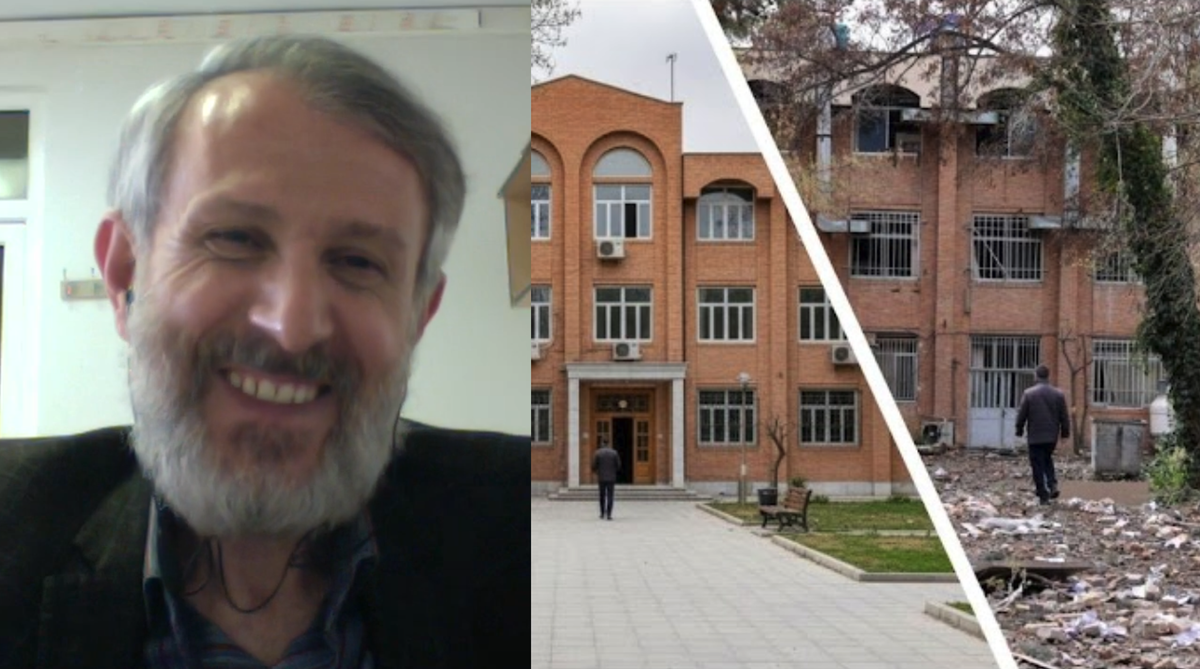
Scientific institutions have long served as neutral ground for international cooperation, places where knowledge transcends borders and political disputes. Now, universities have become targets. During the Ramadan War, numerous Iranian research institutes were attacked, part of at least 60 educational facilities that were bombed.
This interview, conducted during a fragile ceasefire on 15 April, the International Union of Scientists (IUS) speaks with Professor Seyed Mohammad Sadegh Movahed, a physicist at Shahid Beheshti University. Professor Movahed shares testimony from the attacks, analyzes the systematic targeting of Iran’s scientific infrastructure, and issues a call to the global scientific community. The conversation addresses the separation of civilian and military research in Iran, the historical contributions of Iranian science to world civilization, and the role of scientific diplomacy in resisting an imperial strategy to suppress independent development across West Asia and beyond.
Watch here on Rumble or here on YouYube.
Rush transcript
Adam Claridge-Chang (IUS): Today we are joined by Professor Seyed Mohammad Sadegh Movahed of Shahid Beheshti University, a major public research university in Tehran that has been recently affected by ongoing military strikes on academic institutions. Many thanks for joining us, Professor Movahed, under such difficult circumstances. The context of this interview is that Iran was recently attacked during a 40-day war. We are now in a ceasefire. Our audience consists of scientists of diverse specializations. Perhaps you could introduce yourself and your work briefly.
Seyed Mohammad Sadegh Movahed: Thank you very much. First of all, I'm really grateful to have this opportunity to interview under such conditions. I finished my PhD in 2006 at Sharif University of Technology, and just after that I got a faculty position at Shahid Beheshti University, which is the main campus in Tehran. From 2009 until 2017, I was a Junior Associate at ICTP (The Abdus Salam International Centre for Theoretical Physics), located in Italy. This institute was founded by Professor Abdus Salam. Now I am a full professor of physics, working in the Department of Physics at Shahid Beheshti University. Meanwhile, I am a resident researcher at the School of Astronomy at the Institute for Research in Fundamental Sciences (IPM). I am also a joint faculty member of the University of Lahore in Pakistan. Meanwhile, I am supervising Iranian students and hosting foreign students from our region—for example, from Iraq, Pakistan, and Syria.
My field of research focuses on cosmology and complex systems, particularly statistical physics. Some keywords of my work include gravitational wave detection, large-scale structure, phase transitions and critical phenomena. I also use large-scale simulations in the context of physics-informed machine learning and related topics.
ACC: Fantastic. Thank you. So what was the damage to your institute at Shahid Beheshti University during the recent attacks during the war?
SMSM: Unfortunately, my university has been attacked twice. The first one was, as far as I know, around March 27th, and the second time was on April 3rd. At that time, I was in my office at the university when, unfortunately and without any prior warning by the US and Israel, one of the laboratories located in the main campus was targeted. Fortunately, nobody was injured in this attack, but the laboratory was devoted to optical research—laser, optical fiber, optical imaging, brain imaging—and was totally dedicated to civil usage. Unfortunately, it has been damaged and destroyed.
All scientific output from this laboratory has been published in high-impact journals and can be found on the internet. This means that a huge part of the scientific activity in this laboratory was devoted to civil usage, not military use. I personally visited this place just after the bombardment, and it was a very horrible situation. All equipment, including optical tables, analyzers, sensors, and every related instrument for conducting research, has been completely destroyed.
According to international law, attacking schools for teenagers and children, and attacking university institutes, illustrates madness completely far from rationality. This belongs to some war criminal behavior followed by US and Israel, unfortunately, as our enemies. Just after that, I provided a statement and distributed it to some of my international colleagues. In that statement, I emphasized that scientists across the world should condemn such attacks on universities, because if we do not, we anticipate that the US, Israel, and other arrogant powers around the globe will try to attack universities without any justification.
ACC: In the past, Israel has issued evacuation orders to buildings to warn the people inside before bombing them. But what you're saying is that at your university there was no warning, no evacuation order. So the intention really was to not only destroy laboratories but to kill scientists as well?
SMSM: During this attack, they tried to destroy the equipment. But from another perspective, I remember that—yes—they killed five scientists from my university. All of them are scientists. You can find them on the internet and find the output of these scientists. Assassination of scientists is part of the strategy of Israel, of Zionism, according to its doctrine.
ACC: And how have your ongoing research projects been disrupted or destroyed, and how does this loss impact Iranian science and general scientific progress connected to that damage?
SMSM: Since the center is not directly related to my field of research, it has an implicit impact for me. But I have reliable information from my colleagues who are working in this laboratory. The overall activity carried out there—all projects defined for more than 20 Master's students, 10 PhD students, and at least three postdocs—have faced serious problems due to this damage, because after that there was no equipment, no good situation in order to carry out and conduct scientific projects.
But fortunately, because the equipment for scientific activity has been distributed across different universities in Iran, by referring to other laboratories we can mitigate this serious problem and overcome it.
ACC: Right. But still, it's a huge loss of research capacity. And in general, obviously there are people affected directly by the destruction of their laboratory. How are students and junior researchers and the community overall coping with the destruction and the attacks on education, which as you say is a war crime? This is not military targets.
SMSM: You mentioned war crime and criminal behavior by the Zionists. According to my previous statement, I mentioned that by such behavior, the President of the US and the Prime Minister of Israel actually increase their level of war criminality to a new orbit, unfortunately.
Let me come back to your question. Yes, this illegal war undoubtedly leads to increased solidarity between the majority of Iranians with different attitudes. Therefore, this leads to growing resilience among almost the majority of the Iranian people who are patriotic. To be honest and realistic, this bombardment causes a lot of concern from the scientific activity perspective. This concern includes how to complete projects, how to fulfill academic commitments, and achieving the necessities for defense theses.
But as I mentioned before, because the infrastructure for scientific activity is distributed across different universities located in different parts of Iran, by helping other institutes and even by helping international scientists and international institutions, we can mitigate, overcome, and reduce this impact on scientific progress in Iran in the near future. I will discuss and go through the details of how the international community and international scientists can help us during the war and after the war in another part of my talk.
ACC: Your university, Shahid Beheshti, was only one of around 30 universities and institutes targeted during the war. How do you interpret the systematic nature of these Israeli-American attacks on Iran's knowledge base? Do you think this is really a way to weaken Iran by attacking the knowledge centers, the scientists?
SMSM: Yes, actually during the 12-day war that happened last June—just after the war, I wrote a paper distributed in an international magazine, and I tried to clarify some important keywords. The title of this Persian paper was "Patriotism and Science." In that paper, I tried to disclose and clarify that any sign and any agent to protect Iranian sovereignty and the entire Iranian civilization can inherently be a target of attacking according to Israel's strategy, hegemony, and doctrine.
This means that any tool, any person, any scientist, any political person—everybody you can find that follows in order to help increase Iranian sovereignty is inherently a target by Israel. This is my idea.
After that, in order to convince the international community, Israel and the US tried to look for null and empty excuses. They also try to deceive the international community to reduce the cost of eliminating scientists, eliminating scientific institutions, and assassinating scientists. They try to find excuses to decrease pressure from others. Therefore, one can realize that there is a logical and causal correlation between such barbaric behavior by the Zionists and their strategy.
ACC: This is going back to your point about civilian research. The Iranian legal scholar has pointed out that many American universities, including American universities in the Gulf region, conduct military projects which would make them legitimate targets in a war. However, I've heard that Iran has a separation of civilian and military research. Were the universities that were attacked clearly marked as civilian scientific institutions?
SMSM: To give a very brief and clear answer to your question: To the best of my knowledge, in Iran, we have military research centers completely separated from civilian universities. On the other hand, every government needs to conduct military research in order to preserve sovereignty and defend itself against terrorists and any aggression. This is logical—to have such research centers dedicated for the military.
But it turns out that in order to finish and do such projects, and in order to achieve such goals, some scientists from the university may collaborate to fulfill these projects. Doing these projects is totally, as far as I know, carried out and conducted outside the university.
This means that at least Shahid Beheshti University, Sharif University, and other universities targeted by Israel and the US during this illegal war against Iran are totally dedicated to civilian activity, not military. This means that they show such aggression, such barbaric behavior because they didn't find any solution for other parts of the war, and now they're trying madly, far from rationality, to target universities dedicated to civilian activity, not military.
ACC: I don't want my question to imply that targeting even military research is acceptable, because this was a war of aggression, and actually nothing that the US and Israel targeted was justified. That's how international law defines aggression. Just to make that clear.
We have previously witnessed systematic scholasticide in Gaza where pretty much all the universities were destroyed, at least the buildings, and many scholars assassinated. Do you see the attacks on Iranian institutions as part of an American-Israeli imperial strategy to suppress scientific development across West Asia?
SMSM: Yes. My answer is absolutely yes, certainly. There is much evidence to approve my answer. First, in principle, in my opinion as a scientist—I'm not a politician or soldier—I'm just a scientist. From the scientific point of view, science and technology, particularly the convergence of science and technology, which means somehow beyond multidisciplinary activity, can be considered as the foundation of the authority of any society. This is my first statement.
After that, the lack of culture, the lack of civilization brings dependency of any society to other arrogant powers. The lack of science and technology also brings such dependency. In the first part, Iran fortunately is very strong. We have a very deep, very long, and very old civilization—many orders of magnitude higher than the age of the US and Zionist regime, according to history, if somebody takes care about that.
From the perspective of our enemy, it seems that the most accessible measure in order to suppress our development is aggression, attacks, and assassination of Iranian scientists. We will win by persistence. We don't want to pay any ransom to the US and Zionist regime. This is part of our culture. The Iranian people don't want to be humiliated by arrogant powers across the world. I think that by persistence and trust in Almighty Allah, we will soon win in this war again.
By the way, we can see the heritage of the US from our region—for example, in Iraq, Syria, Lebanon, and so on. We don't want to be like such countries. We would like to be independent, and we don't want to pay any ransom to the US.
ACC: Any country that stands independently of the West can be targeted by criticism and even propaganda against the government. Partly for this reason, and also because there are many immigrant Iranians who are critical of the government living in the West, many scientists in the West and even other countries have strongly negative views of the Iranian government. Delegitimizing governments and demonizing citizens is a critical part of imperial warfare and has been a big part of the 47-year war against Iran. What are your thoughts on this topic?
SMSM: Actually, before going to the details of my answer, I highly appreciate you for raising such an important and precise question. This is a very important question. You mentioned two important keywords: delegitimizing of governments and demonizing its citizens. These are two important keywords. I would like to add two more: oppressive sanctions, and creating insecurity in the region by making extremist groups.
One of the main reasons for such hostility is that Iran does not, as I told you, like to be humiliated by any arrogant people. Iran refused to pay any ransom to the United States. History testifies that the US has been making great efforts specifically to access Iranian resources during a long time—during a very long period. To this end, they must constantly spread many lies by using propaganda, and also to reduce international pressure against their illegal behavior, and to convince their people.
Nowadays, you know that the lifestyle of the majority of people is that they usually check the internet, check the news very quickly to find some title, but they don't go through the details. They don't take care about the reliability and robustness of this news. This leads to many misleading and misconceptual ideas about the reality of what happens.
You may probably know that the first structural human right is given by the Cyrus Cylinder. The Cyrus Cylinder is kept in the British Museum, as far as I know. This is related to the ancient Iranian emperor from more than 500 years before Christ. This is another justification that Iranians also pioneered writing about human rights. The Islamic Golden Age is also indebted to the Iranian people. If you look at Islamic medieval history, you can find the contribution of Iranian people to the progress of science and research there.
As far as I know, at least over the last 200 years, Iran has not started any attack while encountering many aggressions from other powers around us. The sanctions also are not only for the military but also for civilians, and lead to increasing and accelerating the economic crisis. This leads to some criticism by other scientists against governance in Iran. But the main reason for these challenges comes from oppressive sanctions at least 47 years ago, during these 47 years by the US.
In addition, they are trying to magnify another important thing. I call this the "false dilemma" between ideology and patriotism. According to my idea, both of these keywords are completely consistent together. This is not a dilemma. This is not a duality between ideology and patriotism.
As you mentioned, in modern war against any power, any country that tries to stand against arrogant people, they try to use many false accusations in order to reduce power, in order to destabilize different parts, and finally they try to achieve the resources of that country. This is part of the modern world.
ACC: What would you say to a Westerner, or even a Western scientist, who says: "Well, you know, I don't support a war of regime change, but the Iranian government is an oppressive regime, a brutal regime, and therefore the Iranian people should remove the government"? This is what's been said by some in the West.
SMSM: Unfortunately, this is part of the lying by propaganda, particularly emphasized by the US. As I told you, if we look back to history, for 47 years ago—just after the Islamic revolution. I was born just four days after the Islamic revolution, so I don't remember anything about that. But according to real history, according to real stories written in reliable books, this revolution was guided by the people, not by some military behavior to change the regime in Iran.
As I said before and emphasized, the people in Iran don't want to pay any ransom to the US, and the US wants to access the resources of Iran because we have a good geopolitical situation in West Asia. My country is almost extended, has a huge area, and we have many resources for petroleum, gas, and so on. We have very huge land borders, and we have access to the Persian Gulf.
Therefore, the US, according to its doctrine—because the US must stay as a superpower—doesn't tolerate finding a new power. The new power in West Asia is somehow Iran. According to that challenge, they try to find any justification, any excuse in order to tune down the pressure by the international community, by the people, and so on. So they emphasize and raise keywords according to delegitimizing and trying to demonize citizens. This is not true.
According to the sanctions against Iran, even me as a scientist—for example, Sharif University of Technology and Shahid Beheshti University also belong to some sanctions—therefore the access of scientists to participate in international activity, in conferences, and so on, encounters many problems. Lacking connection between scientists on one hand, and providing propaganda on the other hand, provides unfortunately a good situation for incorrect and misconception about what reality happens inside Iranian society.
However, I personally exclude those people who are following dictatorship and trying to disturb inside Iran—I exclude all of these persons—but the majority, the majority of Iranians like Iran as a whole. The same as other countries, we have in our governance many problems. Actually, yes, we have many problems. According to our idea, we don't think that any other foreign country can help us. We can refer to our authority inside the country and use different people with different attitudes in order to resolve, to modify our governance, to improve the governance. This is what we want. But unfortunately, the US wants to have all resources, particularly petroleum, particularly human resources. That's why they try to distribute such lies according to its associated propaganda.
ACC: Thank you. So, the letter—I believe that you were the author of the letter to protect Iranian science, is that correct?
SMSM: Yes, I had a contribution for that, and after that I separately provided a statement and distributed it in the international community.
ACC: The letter to protect Iranian scientists and science has gathered over a thousand signatures from global scientists, including several Nobel laureates and a Dirac medalist. What can international colleagues do to help Iranian science and scientists and Iran in this crisis?
SMSM: I appreciate my colleagues across the globe who are committed and follow their duty against aggression. The international scientific community must adhere to scientific values and condemn the sanctions against Iranian scientists and Iranian universities, because some Iranian universities and almost all scientists in Iran have suffered from serious problems due to these sanctions. We are not able to buy equipment for laboratories simply. Also, in order to contribute and participate in international conferences, we have challenges ranging from getting visas and going into that. But if you look at high-rank journals, you can find that many Iranian scientists have good contributions, publish very high-rank papers.
I mentioned that before: ICTP also has very good support for Iranian scientists, more than other centers, and I appreciate ICTP. I would like it to be a good role model and good example for other international institutions.
ACC: What is ICTP? I'm not familiar with it.
SMSM: International Centre for Theoretical Physics, founded by Abdus Salam. He was a Nobel laureate from Pakistan. This is a very good place as a hub, the connection between famous scientists across the globe and developing countries, particularly from East and West Asia, particularly in Iran, India, and so on. They provide very good facilities for us. As I told you, I was for about 10 years as a Junior Associate, and according to this capacity, I usually visited this center during the summer and made collaborations and connected with other international scientists. This is a very good environment to help us progress our ideas and contribute. Now let me give you some list of proposals to help us by international scientists and the international community.
First, I think that my colleagues across the globe must not permit reducing the cost of scientist assassination by the US and Zionist regime across the world, particularly in Iran. This is my first demand.
Second, they should put pressure on the political sector to create conducive conditions for negotiation while respecting Iran and considering Iranian rights without any humiliation. This is my second proposal and demand.
Third, try to help diminish all sanctions, all oppressive sanctions against Iran, particularly against scientists and scientific institutions, because these sanctions lead to significant delay in our progress.
Another one is to provide facilities for scientific cooperation in general, and also making fast-track for student and faculty member exchange. We don't want to provide a one-way direction for migration of all students and faculty, but we are trying and emphasizing on exchange between them. As I told you, last year I was the host of one PhD student from Pakistan—she came to my university for her sabbatical.
Another proposal is opening postdoctoral positions particularly for Iranian scientists. Then, donating lab equipment in order to renovate our laboratories damaged and attacked during this illegal war imposed by the US and Israel against Iran.
If such proposals can be considered by my colleagues from across the globe, I think they have at least two impacts for us. One is devoted to this fact that it enables Iranian governance to resolve its challenges and improve the governance from the scientific point of view, because we improve the connection and feedback between the scientific community inside Iran and the governance, enabling us to modify and reduce challenges, to improve our governance smoothly.
Establishing such scientific diplomacy also leads to mitigate some misconceptions. In part of your question, you mentioned that some scientists in the West have bad notions and perspectives against Iranian governance. By establishing such scientific diplomacy, I personally think that they will reduce these misconceptions from the scientific point of view. This is part of my proposal.
ACC: That's great. Thank you. Looking beyond the current crisis—and one day it will come to an end—how do you envision Iranian science contributing to a better world, and what are your dreams for education and research in Iran and elsewhere?
SMSM: Actually, in order to give my answer, let me emphasize the history of science. According to the history of science, we can find that Iranian people have always played a constructive role in the progress of science for long periods, particularly in the medieval Islamic period. For example, you may know Avicenna, Al-Biruni, Al-Khwarizmi, Ibn al-Haytham—he was the pioneer in modern optics.
I checked on the internet and found that in Vienna, there is a statue of four famous ancient Iranian scientists: Al-Khwarizmi, Al-Biruni, and I think the next ones include Ibn Sina and others. Therefore, according to this history, we eventually realize that usually Iranian people, from this long civilization, have a constructive rather than destructive role in the progress of science and civilization, not only in Iran but also across the world.
And not just scholars, but all people—decent, dignified, and noble persons, particularly those studying in the university—usually take care about at least four fundamental impacts and commitments. What does it mean? They try to increase leadership, try to increase social empathy, try to increase problem-solving, and creation. These are somehow the four foundational parts of elite impact to improve lifestyle.
Having such facts in hand, I think that Iran certainly contributes constructively in the world, as proven before. If you ask me about my dream for Iran, I can give you a very short answer: My dream is to institutionalize the insight and vision that the greater intellectual activity and greater intelligence capacity leads to greater responsibility with respect to human nature. By providing opportunity for the growth and flourishing of Iranian talents and elites, more than ever before, for better governance.
And also the circulation and mobility of talents and science in our region and internationally. We emphasize that because we have good capacity in our region, and we can try to set up mobility and increase scientific policy in order to reduce misconception, as I stated before. And finally and ultimately, achieving Iran's dignity and majesty.
ACC: It's a wonderful dream to think of. Thank you, Professor. I appreciate all your thoughts and insights into this situation.
SMSM: Thank you very much for having me for this interview. Thank you. Have a nice day, and thanks for joining. Hope to see you in the near future, particularly in Iran, to show you the realistic situation in Iran, which is completely far from that provided by many or almost a huge part of the media.

Comments ()