
Stand with Cuban Science and Education: A Call for International Scientific Solidarity
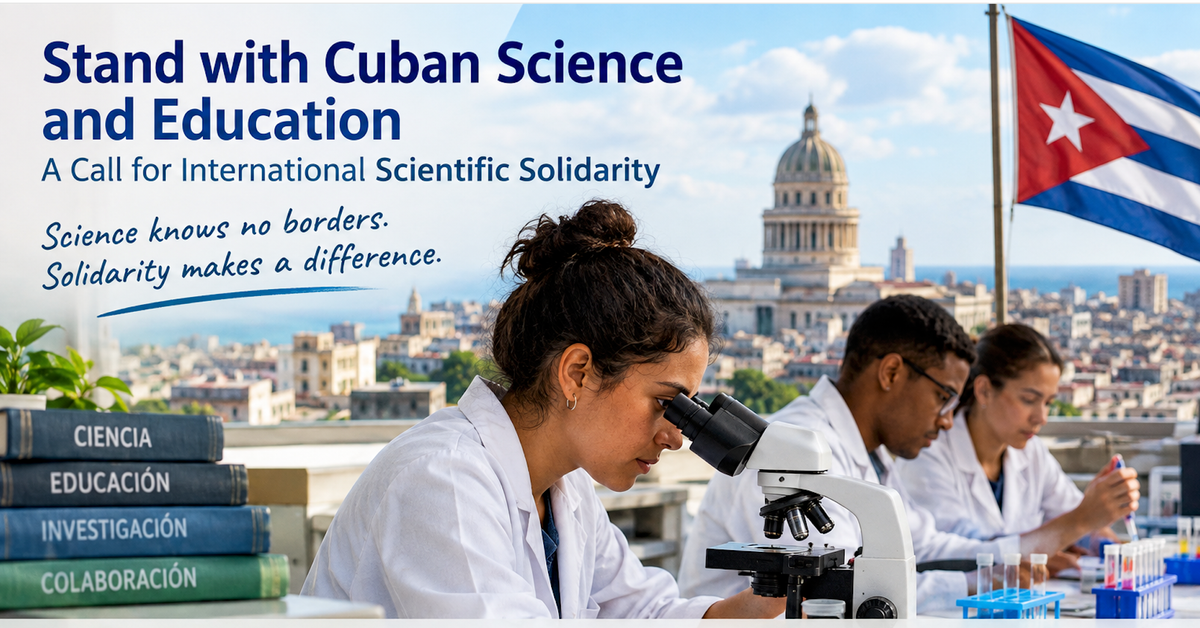
Science and education are global public goods. They should not become casualties of political conflict.
Cuban science and education are facing an increasingly severe crisis. The long-standing U.S. economic sanctions against Cuba have created significant barriers to access to equipment, technology, financing, scientific exchange, and international collaboration. These restrictions led to a deepening economic and energy crisis that are disrupting the basic infrastructure on which universities, laboratories, and schools depend.
The consequences are becoming increasingly difficult to ignore. In September 2026, Cuba has experienced severe fuel and electricity shortages, with prolonged power outages affecting essential services and infrastructure. Recent reporting has documented how the energy crisis has disrupted water systems, healthcare facilities, and other essential services across the country [1].
The U.S. sanctions regime itself remains extensive. The U.S. Treasury's Office of Foreign Assets Control (OFAC) maintains a comprehensive Cuba sanctions programme encompassing trade, financial transactions, travel, investment and other activities [2].
The restrictions also directly affect academic exchange. Effective September 30, 2026, OFAC narrowed the authorization for U.S. academic institutions, faculty and students to engage in certain educational activities involving Cuba. It also removed the previous authorization for group people-to-people educational travel and introduced additional restrictions concerning transactions involving entities on the Cuba Restricted List. At the same time, certain forms of academic exchange and joint non-commercial research remain authorized under specified conditions [3, 4].
For science and higher education, the implications are particularly serious. Modern research depends on reliable electricity, functioning laboratories, scientific instruments, imported components and consumables, computers and internet connectivity, access to scientific literature, and the ability to collaborate internationally. When these foundations are weakened, even highly capable scientists can find it increasingly difficult to conduct experiments, train students, maintain equipment, or produce research at an internationally competitive level.
The effects of the U.S. sanctions regime on scientific research and collaboration are not new. Restrictions affecting trade and financial transactions can make it difficult for Cuban institutions to obtain scientific equipment, components, reagents, software, and other materials needed for research. The resulting difficulties are particularly significant for experimental disciplines that depend on specialized and often imported equipment. Nature Magazine has documented how U.S. sanctions have created difficulties for Cuban scientists seeking scientific equipment and materials [5].
Education is likewise under severe pressure. Recent reporting has described shortages of electricity, transportation and educational supplies as Cuba begins the 2026–27 academic year. The crisis therefore threatens not only existing research programmes but also the education and training of the next generation of Cuban scientists.
And yet, Cuban scientists continue to teach, conduct research, publish and collaborate internationally. Cuba has developed internationally recognized scientific capabilities, particularly in biotechnology, medicine and public health. International collaboration has been an important mechanism through which Cuban researchers have sustained scientific activity despite severe resource limitations due to the US Blockade.
This is precisely why international scientific solidarity is needed.
What Can we do?
Solidarity does not have to mean large institutions or large financial commitments. There are many concrete ways in which universities, scientific societies, professional associations, research groups and individual scientists can support our colleagues and students in Cuba. A useful initiative in this regard is CubaScience.eu, which has been created to help coordinate such efforts.
1. Listen to and amplify Cuban scientists
Publish interviews and first-hand accounts from active Cuban scientists describing the realities they face. See for example an IUS interview with Dr. Ernesto Estévez Rams at University of Havana on Cuban Science Under Siege. Many scientific organizations and individuals do not have an up-to-date understanding of the condition of research infrastructure in Cuba or of how sanctions and restrictions affect different scientific fields.
The situation is also uneven. Infrastructure associated with medicine and biotechnology is generally better equipped than that available in many other academic fields. Researchers in areas such as physics, chemistry, materials science, and other experimental disciplines can face particularly severe difficulties in maintaining functional instruments.
Giving Cuban scientists a platform to describe their own experiences is an important first step toward informed international solidarity.
2. Build research collaborations
International collaboration is essential. In many areas of the physical sciences, researchers face shortages of functional instruments and equipment needed for characterization, measurement, and experiments at the level required for contemporary research and publication.
Joint projects can help by sharing facilities, expertise, experimental capabilities, data, and methodologies. Scientific collaboration is not simply an exchange of knowledge—it can provide access to resources that are otherwise unavailable.
3. Organize scientific workshops in Cuba
Universities and scientific organizations can organize workshops in Cuba for students, young researchers and professionals, providing them with access to recent developments, techniques, and ideas across scientific fields.
Such workshops can also create the foundations for longer-term collaborations and help identify specific needs that international collaborators can address.
4. Help repair existing scientific instruments
A considerable amount of valuable scientific equipment may remain unusable because of missing or damaged components rather than because the entire instrument has become obsolete.
Researchers can collect lists of required spare parts directly from Cuban colleagues and help obtain and deliver them, where legally and logistically possible, including through legitimate travel.
5. Facilitate access to refurbished scientific equipment
Scientific institutions can identify equipment that is no longer needed but remains functional, or arrange for professionally refurbished instruments to be made available to Cuban universities and research centres.
This requires coordination, technical expertise, transportation and appropriate institutional arrangements, but even a small number of carefully selected instruments could make a substantial difference to a laboratory.
6. Send basic laboratory consumables
Basic laboratory consumables can be just as important as sophisticated instruments. Where legally and logistically possible, small shipments of essential materials can help research and teaching laboratories continue operating.
Even modest contributions can enable teachers and students to conduct practical experiments that would otherwise be impossible.
7. Support teaching infrastructure
Scientific solidarity does not have to be limited to research. Basic educational materials—including printer toner, office supplies, small projectors, and other teaching equipment—can help teachers maintain educational activities under difficult conditions.
Such seemingly modest contributions can have a direct impact on students and educators.
8. Help address electricity and energy constraints
Reliable electricity is fundamental to modern education and research. Laboratories require stable power for computers, instruments, refrigeration, communications and other essential equipment.
One practical initiative is to provide small solar power stations in the 1–4 kW range, where appropriate and legally feasible. Where possible, purchasing equipment locally in Cuba may reduce shipping and logistical difficulties.
9. Help expand access to scientific information
Access to current scientific literature remains an important challenge. Researchers can help by expanding access to legally available scientific information through open-access publications, institutional repositories, preprints, author-archived manuscripts, open educational resources, and legitimate library or interlibrary-loan arrangements.
A network of international colleagues can also respond to specific literature requests by helping Cuban researchers locate legally accessible versions of papers or by sharing articles when permitted by the relevant publisher or licence.
Science without borders
Scientific collaboration has repeatedly demonstrated its ability to build bridges even when political relations are difficult. Studies on scientific collaboration demonstrate that scientific links expanded during periods when political restrictions were eased, highlighting the importance of reducing barriers to international scientific exchange.
The current difficulties make international solidarity even more important.
Supporting Cuban science does not require scientists to agree on every political question. It requires recognition that students should be able to learn, teachers should be able to teach, and researchers should be able to pursue knowledge, regardless of political boundaries.
We therefore call on universities, scientific unions, academies, research groups, professional associations and individual researchers to ask their Cuban colleagues a simple question:
What do you need, and what can we do together to help?
Sometimes the answer may be a research collaboration. Sometimes it may be a spare part, a box of laboratory supplies, access to a paper, a workshop, a refurbished instrument, a source of reliable electricity, or simply an opportunity to tell the world what is happening.
Scientific solidarity begins with listening—and becomes meaningful through concrete action.
Comments ()